
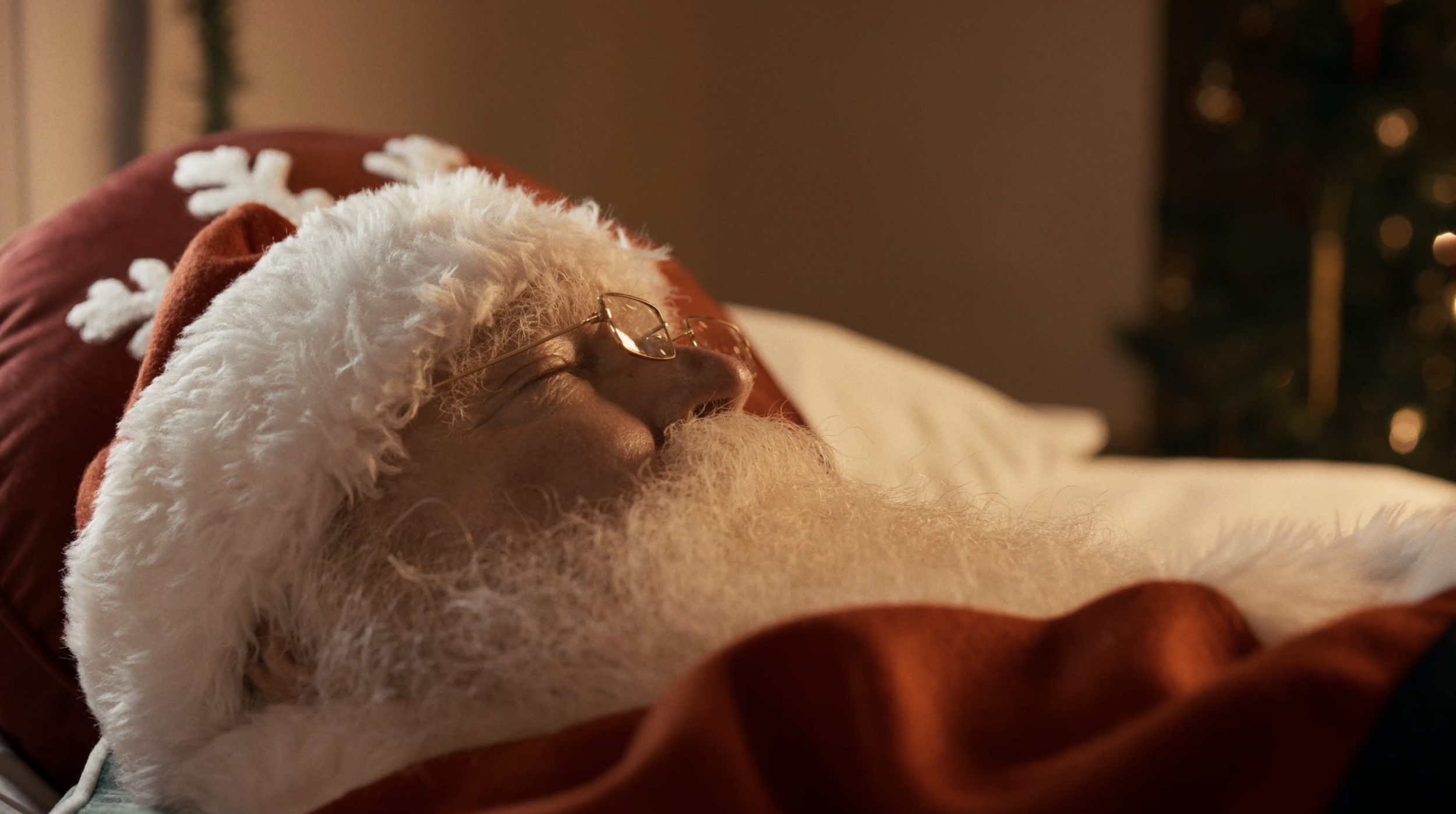
Every December, somebody at Coca-Cola has one of the hardest jobs in advertising. They have to follow a painting from 1931.
That year an illustrator named Haddon Sundblom painted Santa Claus for a Coke magazine ad. Coca-Cola didn't invent the red suit. Thomas Nast had been drawing Santa in red for decades before that. What Sundblom gave him was a face. He used a friend of his, a retired salesman named Lou Prentiss, as his model. When Prentiss died, Sundblom painted Santa looking at himself in a mirror. He kept painting that Santa for Coke until 1964.
If you picture Santa right now, the round cheeks and the warm eyes, there's a good chance you're picturing a man looking into a mirror with a brush in his hand. That's the bar. One person made a specific choice about what Santa looks like, and it stuck for almost a hundred years.
The trucks
In 1995 Coke started a second tradition. A line of glowing red trucks rolls through a snowy town while "Holidays Are Coming" plays. They shot it in Vancouver with three real trucks and 40 actors. Then Industrial Light & Magic, the effects company behind Star Wars, turned those three trucks into a whole fleet.
I bring up ILM on purpose. That ad wasn't against technology. It used the best visual effects money could buy in 1995. But the effects were built on top of something real. Real snow, real trucks, real people on set looking up as the lights went by. The technology served the shoot.
Then the machines made it
In 2024 Coca-Cola remade the trucks ad with generative AI. In 2025 they did it again. That version took about 100 people, including five AI specialists who generated and refined more than 70,000 clips. Coke's CMO said the process cut their timeline from about a year to about a month.
People didn't love it. Viewers pointed out animals that shifted between realistic and cartoonish from shot to shot. One social listening firm tracked positive sentiment about the ad dropping from 23.8% before launch to 10.2% after.
I don't think the problem was the tool. ILM was a tool too. The problem is that nobody can point at a frame and say a person decided that. When you generate 70,000 clips and keep the ones that hold together, that's closer to picking than making. Audiences can feel it, even if they couldn't tell you why.
There's data behind that feeling. An IAB study found that 82% of ad executives believe Gen Z and millennial consumers feel good about AI-generated ads. Only 45% of those consumers say they do. The people making the ads and the people watching them are looking at the same thing and seeing something different.
This year the pencils came back
Look at the big holiday ads for 2026 and you'll see a lot of brands going the other direction.
Prada called its campaign "Drawing Prada: Animated By Hand." Every animated frame is drawn by hand, led by a veteran animator named John Pomeroy, and layered over live action. In Pomeroy's words, "I learnt my craft with pencil and paper, through traditional, analogue drawing."
RIMOWA built little stop-motion worlds inside its suitcases out of wood, clay, felt and paper. Levi's made a stop-motion yeti named Gus. Etsy's film, directed by Autumn de Wilde, cuts between a factory assembly line and the people who make gifts by hand, a trainmaker and a dollmaker. The doll at the end is made to look like the little girl who opens it.
These are different brands with different creative teams, and they landed in the same place. When anyone can generate a nice-looking image in a few seconds, a nice-looking image stops meaning much. What still means something is proof that a person cared enough to make it.
What this means if you're not Prada
The thing these brands are spending millions to prove, that real people made this, is something a local business already has. You have a real shop, a real crew, and customers who know your name. The question is whether your marketing shows any of it.
Here's what I'd tell any business owner going into next year.
Put your real people on camera. A stock photo of a smiling contractor is the small-business version of an AI ad. People can tell it isn't you, and it gives them no reason to remember you.
Shoot where the work happens. The shop floor, the kitchen before open, the job site at 7 in the morning. The location does a lot of the storytelling for you.
Give credit to the hands. If a person built it, say who. We've started ending our films with credits, the crew, the location, the people on screen, the same way a movie does. It costs nothing and it tells the viewer a real team made this.
Use AI for the back office. We use it too, for transcripts, scheduling, first drafts of notes. Keep it away from the part where a customer is deciding whether to trust you.
Sundblom's Santa lasted because one person sat down and decided what Santa's face should look like. The trucks lasted because a crew stood in the snow in Vancouver and filmed real people watching them go by. The tools have changed a lot since then. The job hasn't. Somebody still has to make the thing, and people can tell when somebody did.